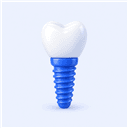
Dental implants
Dental implants: national health insurance
At a glance
Dental implants are covered by national health insurance for people aged 65 and over who still have some teeth (partially edentulous). Here is who qualifies, how many implants are covered and how much you pay, based on the National Health Insurance Service (NHIS).
Source · 국민건강보험공단 「치과임플란트 급여안내」 (Checked 2026-11-20)
Cost statistics
HIRA non-covered fee statistics, dental clinics nationwide
Still collecting data
These figures are collected from HIRA public data on non-covered fees. They are not the price of any one clinic.
What we cover
What is a dental implant?
It replaces a missing tooth with an artificial one. An artificial root made of titanium alloy is fixed in the jawbone, and an artificial tooth is attached on top of a connecting post (abutment).
Source · 국민건강보험공단 「치과임플란트 급여안내」 (Checked 2026-11-20)
Who is covered
NHIS subscribers and dependants aged 65 and over are eligible. It applies to people who still have some teeth (partially edentulous); people with no teeth at all (fully edentulous) are excluded.
Source · 국민건강보험공단 「치과임플란트 급여안내」 (Checked 2026-11-20)
Coverage is limited to 2 implants per person for life. If treatment has to be stopped on the dentist's medical judgement, that implant does not count toward the 2.
Source · 국민건강보험공단 「치과임플란트 급여안내」 (Checked 2026-11-20)
It applies to any position in the upper or lower jaw. You can also receive insurance for a partial denture at the same time.
Source · 국민건강보험공단 「치과임플란트 급여안내」 (Checked 2026-11-20)
What you pay and what is not covered
Insured people pay 30% of the total covered cost. Near-poverty-line patients with rare or intractable diseases pay 10% and those with chronic diseases pay 20%; Medical Aid type 1 recipients pay 10% and type 2 pay 20%.
Source · 국민건강보험공단 「치과임플란트 급여안내」 (Checked 2026-11-20)
The whole procedure is not covered if it is done on a fully edentulous patient, if the implant is placed through the upper jaw into the cheekbone (zygoma), if a one-piece implant is used, or if the crown is anything other than a non-precious porcelain-fused-to-metal (PFM) crown.
Source · 국민건강보험공단 「치과임플란트 급여안내」 (Checked 2026-11-20)
How to apply and aftercare
After an examination, the dental clinic confirms you are eligible and you register at the clinic where you will be treated. The clinic can register on your behalf; treatment starts after NHIS notifies the result.
Source · 국민건강보험공단 「치과임플란트 급여안내」 (Checked 2026-11-20)
Within 3 months after the crown is fitted you pay only the consultation fee. After 3 months, maintenance related to the crown is not covered.
Source · 국민건강보험공단 「치과임플란트 급여안내」 (Checked 2026-11-20)
Common questions
Q1From what age is the implant covered?
NHIS subscribers and dependants aged 65 and over are eligible.
Source · 국민건강보험공단 「치과임플란트 급여안내」 (Checked 2026-11-20)
Q2How many implants are covered?
Up to 2 per person for life.
Source · 국민건강보험공단 「치과임플란트 급여안내」 (Checked 2026-11-20)
Q3Is it covered if I have no teeth at all?
No. Treatment for a fully edentulous patient is entirely not covered.
Source · 국민건강보험공단 「치과임플란트 급여안내」 (Checked 2026-11-20)
References
- 국민건강보험공단 「치과임플란트 급여안내」 (Checked 2026-11-20)
- HIRA (건강보험심사평가원) (September 2026)